

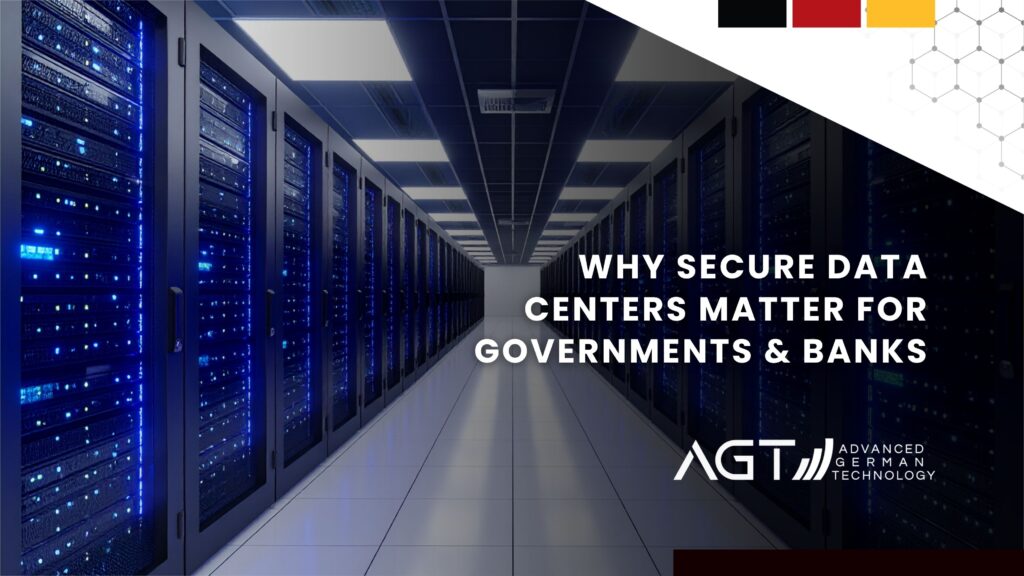
Why Secure Data Centers Matter for Governments & Banks
As governments and financial institutions accelerate their digital transformation, data has become one of their most valuable assets—and one of their most attractive targets. Government records, banking systems, citizen information, financial transactions, and critical national services all depend on reliable and secure digital infrastructure. Why Secure Data Centers Matter for Governments & Banks?
At the heart of this infrastructure is the data center. A high-security, resilient data center is no longer simply a facility that houses servers. It is a critical foundation for national security, financial stability, business continuity, and efficient digital government services.
Protecting Critical Government and Financial Data
Government agencies and banks manage vast amounts of highly sensitive information. A security breach, system outage, or physical incident can have consequences far beyond the loss of data. It can disrupt essential public services, affect financial markets, damage public trust, and create significant economic and national-security risks.
For this reason, modern data center security must address both cybersecurity and physical security. International security frameworks, including NIST guidance, emphasize a comprehensive approach that covers areas such as access control, incident response, contingency planning, system integrity, and physical and environmental protection.
Leading technology organizations demonstrate the importance of a layered approach. Google, for example, describes multiple physical security layers combined with controls that protect the space between physical access and the logical systems running on servers. AWS similarly describes perimeter security, controlled physical access, security personnel, surveillance, and intrusion detection as part of its data center protection strategy.
Making Government and Banking Operations More Efficient
A secure data center is not only about preventing attacks. It is also about keeping essential services available and enabling organizations to operate more efficiently.
When critical systems are hosted in a properly designed and protected environment, government departments and financial institutions can benefit from:
- Higher availability of critical applications and services
- Centralized and controlled access to sensitive information
- Faster and more reliable digital services for citizens and customers
- Improved business continuity and disaster recovery
- Better monitoring and incident response
- Stronger regulatory compliance and risk management
- More efficient management of IT infrastructure and resources
For governments, this can mean faster delivery of e-government services and more reliable access to national digital platforms. For banks, it can support secure transactions, uninterrupted customer services, and resilient financial operations.
Security Must Be Designed in Layers
The most effective data centers follow a defense-in-depth philosophy. No single security technology can protect a critical facility against every possible threat.
A high-level secure data center should consider multiple layers, including:
- Physical Security: Secure perimeters, controlled entry points, visitor management, surveillance, intrusion detection, and secure server areas.
- Environmental Protection: Fire detection and suppression, temperature and humidity control, water-leak detection, and protection against environmental hazards.
- Power and Availability: Redundant power systems, UPS, backup generators, and resilient infrastructure to reduce the risk of service interruptions.
- Cybersecurity: Network segmentation, secure configurations, encryption, identity and access management, continuous monitoring, and incident response capabilities.
- Operational Resilience: Backup strategies, disaster recovery, business continuity planning, and regularly tested response procedures.
This integrated approach is essential because a sophisticated threat can target both the digital and physical environment. Google’s infrastructure security model, for example, combines multiple physical controls with logical security measures and monitoring to create layered protection.
A Strategic Investment in Digital Transformation
For countries building or modernizing their digital infrastructure, investing in secure data centers should be viewed as a strategic national capability, not simply an IT project.
A well-designed data center can provide the secure foundation required to connect government institutions, support banking and financial services, host critical applications, and enable future technologies. It can also help organizations establish a more consistent approach to security, governance, resilience, and operational efficiency.
The goal is not simply to build a facility that stores data. The goal is to create a trusted, resilient, and secure digital foundation that allows governments, banks, and critical institutions to operate confidently today while preparing for tomorrow’s challenges.
How AGT Can Help
AGT can support organizations in developing a comprehensive approach to secure data center infrastructure and physical security. From security strategy and risk assessment to the design and integration of physical security solutions, AGT can help organizations align their infrastructure with international best practices and the specific requirements of critical environments.
By combining physical security, cybersecurity, infrastructure protection, and operational resilience, AGT helps organizations build a stronger foundation for secure digital transformation—protecting critical data while enabling more reliable, efficient, and resilient services.