

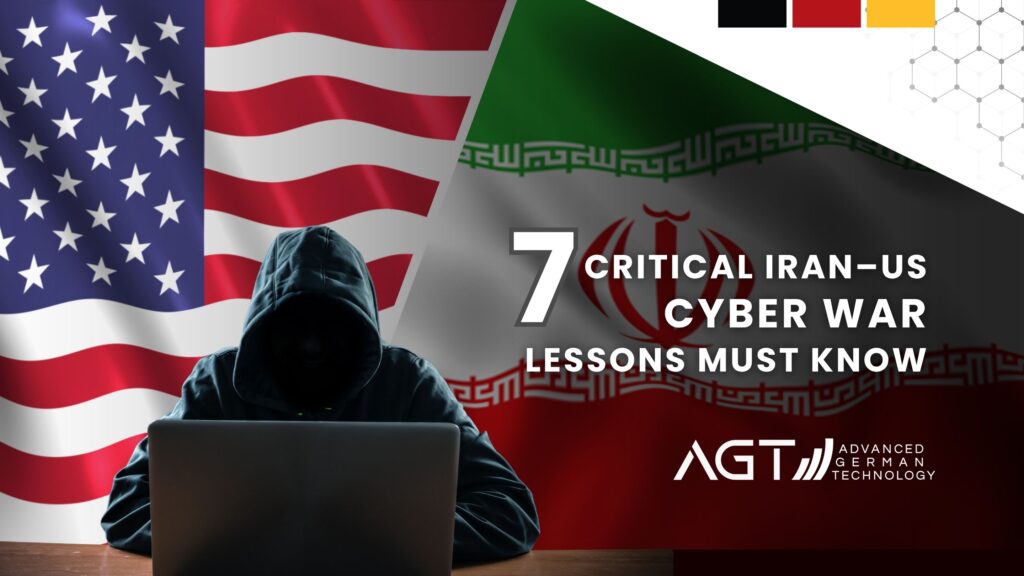
Iran–US Cyber War: A New Battlefield Beyond Missiles
7 Critical Iran–US Cyber War Lessons Must Know
The Iran–US cyber war has become one of the most significant examples of modern digital conflict. While military operations often dominate headlines, cyberattacks have evolved into a strategic weapon capable of disrupting governments, critical infrastructure, financial institutions, healthcare providers, and global businesses without firing a single missile.
Over the past decade—and particularly during periods of heightened geopolitical tensions—both defensive and offensive cyber operations have increased dramatically. Cyber espionage, ransomware, hack-and-leak campaigns, phishing operations, disinformation, and attacks against Operational Technology (OT) have become integral components of modern warfare.
For governments, banks, energy companies, airports, telecommunications providers, and critical infrastructure operators, understanding these threats is no longer optional—it is essential. 7 Critical Iran–US Cyber War Lessons Must Know
Major Iran–US Cyber Incidents That Shaped Modern Cyber Warfare
Several incidents have demonstrated how cyber capabilities can influence geopolitical conflicts while affecting organizations worldwide.
1. Critical Infrastructure Under Constant Threat
Iranian state-linked cyber groups have repeatedly targeted critical infrastructure, including water systems, energy facilities, industrial control systems (ICS), and Operational Technology (OT). In recent years, U.S. cybersecurity agencies have warned that Iranian threat actors increasingly exploit internet-connected industrial devices to disrupt operations and create financial damage.
2. Election and Government Targeting
Cyber espionage has expanded beyond infrastructure. Multiple investigations have linked Iranian threat actors to sophisticated spear-phishing campaigns targeting U.S. political organizations and government officials. These operations focused on credential theft, intelligence gathering, and influence activities rather than immediate disruption.
3. Cyber Operations During Military Escalation
Recent regional conflicts have shown that cyber operations often accompany military actions. During periods of heightened tensions, researchers observed attacks against government websites, digital services, communication platforms, and public-facing applications, demonstrating that cyber warfare has become an integrated part of modern conflict strategy.
What Organizations Can Learn from the Iran–US Cyber War
The biggest lesson is clear: no organization is too small or too large to become a target.
Today’s attackers often combine multiple techniques instead of relying on a single exploit.
Organizations should prioritize:
- Zero Trust Architecture
- Multi-Factor Authentication (MFA)
- Continuous vulnerability management
- Threat Intelligence integration
- Security Operations Center (SOC) monitoring
- Incident Response planning
- Employee cybersecurity awareness training
- Regular penetration testing and Red Team exercises
- Operational Technology (OT) security
- Third-party supply chain risk management
Many successful nation-state attacks begin with relatively simple weaknesses such as compromised credentials, exposed remote services, phishing emails, or unpatched vulnerabilities before escalating into larger breaches.
Why Critical Infrastructure Faces the Greatest Risk
Energy providers, banks, healthcare organizations, airports, telecommunications operators, transportation systems, and government agencies remain among the highest-value targets for nation-state attackers.
These sectors frequently operate:
- Legacy systems
- Internet-connected industrial equipment
- Large attack surfaces
- Multiple third-party integrations
- Mission-critical services
Even a short disruption can result in financial losses, operational downtime, reputational damage, and risks to public safety.
This explains why agencies worldwide continue issuing cybersecurity advisories encouraging organizations to strengthen resilience before—not after—an attack occurs.
How AGT Helps Governments and Critical Infrastructure
As cyber threats continue to evolve, organizations require more than traditional security solutions—they need proactive cyber resilience.
AGT – Advanced German Technology delivers comprehensive cybersecurity services designed to help governments, financial institutions, military organizations, healthcare providers, energy companies, airports, telecommunications operators, and critical infrastructure defend against today’s most advanced cyber threats.
Our capabilities include:
- Security Operations Center (SOC)
- Threat Intelligence
- Penetration Testing
- Red Team & Blue Team Assessments
- Incident Response & Digital Forensics
- Zero-Day Attack Preparedness
- Vulnerability Assessments
- OT & ICS Security
- Security Awareness Training
- Cybersecurity Consulting
- AI-powered Security Solutions
Whether preventing sophisticated cyberattacks, responding to active incidents, or improving long-term cyber resilience, AGT helps organizations reduce cyber risk while ensuring business continuity and operational security.
Learn more at www.agt-technology.com
Final Thoughts
The Iran–US cyber conflict demonstrates that modern warfare increasingly extends into cyberspace. Nation-state cyber operations are no longer isolated events—they are continuous campaigns that target critical infrastructure, governments, businesses, and public services.
Organizations that invest in proactive cybersecurity, employee awareness, threat intelligence, and rapid incident response will be significantly better positioned to withstand the next generation of cyber threats.
Cyber resilience is no longer just an IT objective—it is a strategic business and national security priority.